Data, Signals, and Intelligence: Where AI Companies Can Differentiate
FIELD NOTES by Joyce J. Shen
Foundation models keep improving, and the leading models are now close in quality. Stanford's 2026 AI Index reports that the top four models on the Arena leaderboard were separated by fewer than 25 points as of March 2026. In April 2026, Gartner reported a related finding about enterprises. That is good news for enterprises adopting AI because enterprises have more options and potentially more bargaining power on price. It also means the model rarely separates one AI company from another anymore. Even more important than before, one source of differentiation beyond model choices comes from data. More specifically, the said differentiation comes from data that produces signals and intelligence a business can act on.
What counts as data in AI?
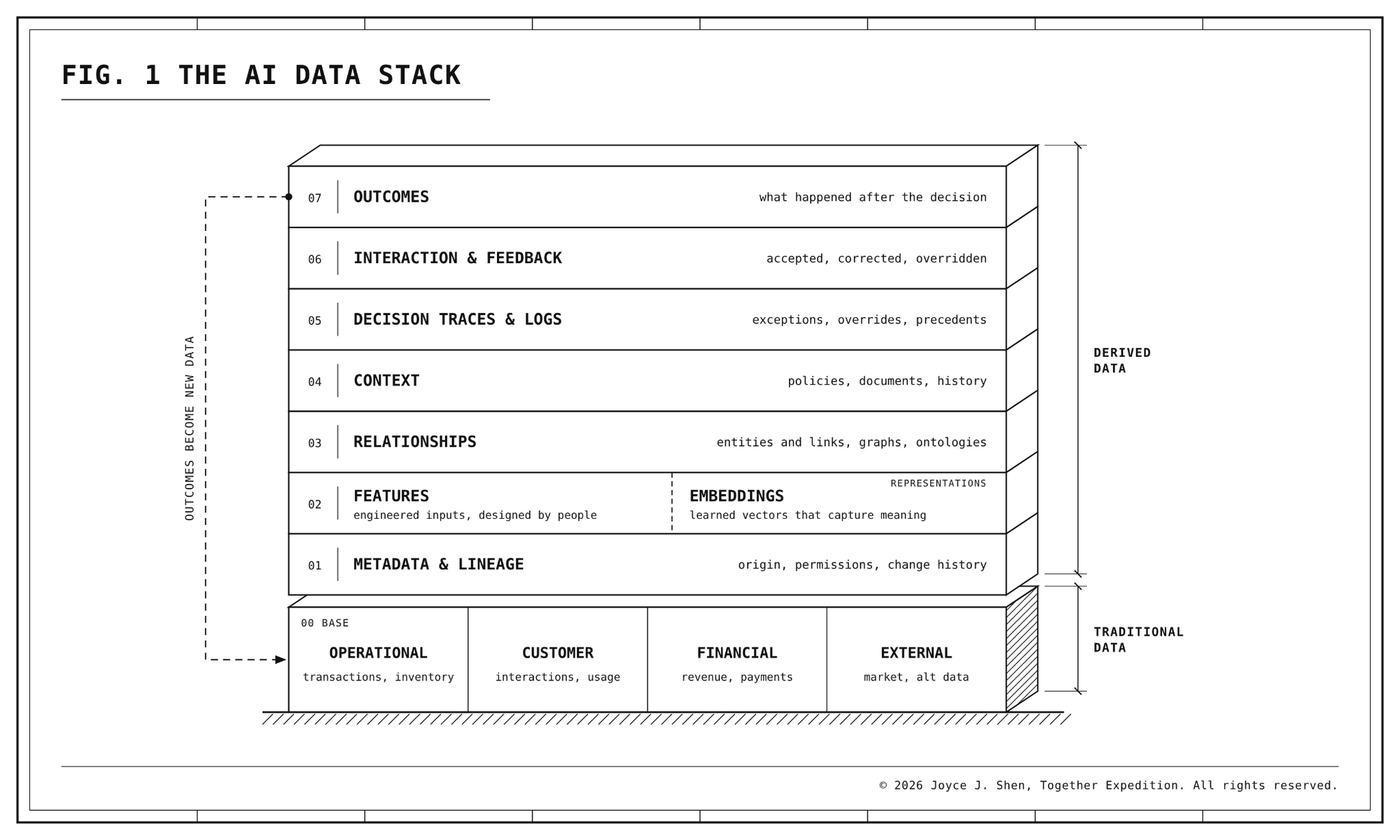
Traditionally, data to many organizations means the following:
- Operational data covering areas such as transactions, inventory, production, and the systems of record that run the business.
- Customer data covering areas such as interactions, usage, and service history.
- Financial data covering areas such as revenue, costs, balance sheet, cash, payments, and credit exposure.
- External data covering areas such as market and regulatory information, along with alternative data that complements a company's own records.
It is obvious that data does not equate to intelligence. AI depends on data because data is the source of generating representations and patterns for algorithms to generalize at scale. Useful and relevant representations and patterns provide the basis of signals that businesses may find interesting. Verified, consistent, rich, and persistent signals are insights. The compounding of insights along with context and know-how engender intelligence. Signals is a type of derived data but there are other types of derived data such as the following:
- Metadata and lineage record where data came from, who may use it, and how it has changed. Metadata and lineage data are data themselves.
- Features are the engineered inputs a model learns from. In supervised learning, a model learns to map features to known outcomes, which we call labels. A lender's features might include payment history, utilization trends, and changes in cash flow. Features are where raw data is shaped and crafted into signals. Well-designed features often reflect years of domain knowledge because features hold an important key to proper pattern representations and signals from the data.
- Embeddings turn documents, records, and images into numerical vectors that capture meaning. They enable a system to find related information even when the wording differs. Embeddings power the retrieval behind many enterprise AI systems. Embeddings also need governance because, for example, embeddings of sensitive data deserve the same protection as the data itself.
- Relationships describe how customers, counterparties, products, and locations connect to one another. Knowledge graphs and ontologies capture this layer. Palantir, for example, describes its ontology as an operational layer that maps an organization's data into objects, properties, and links.
- Context includes the policies, documents, and history that are relevant for a specific decision at the moment the decision is made.
- Decision traces and logs capture the reasoning behind a decision, including exceptions, overrides, and precedents.
- Interaction and feedback data show how humans and AI agents use a system. They record what users accept, correct, or override.
- Outcomes record what actually happened after a decision.
These components make the AI data stack. What’s nice about this view is that it is a strategic data view from which infrastructure, tooling, governance, processes, and workflows can be elucidated.
Several of the durable data businesses in the public markets already think this way. For example,
- Palantir organizes an enterprise's data into objects and links through its ontology, with actions and business logic built on top.
- Tempus AI generates data through its diagnostic testing labs and connects to clinical records. The company reports that many of its data profiles are regularly updated with clinical outcome and response data. The company has more than 8.6 million de-identified patient records.
- Samsara connects vehicles, equipment, and sites in physical operations, from logistics fleets to construction. Its data platform processed more than 25 trillion data points during the year and learned from these data.
These companies took years to build their positions as data and intelligence infrastructure for industries they want to serve. For an early-stage investor, the question is where similar positions are forming now.
At Together Expedition, we focus on B2B data + intelligence companies that are mission-aligned, fill critical data gaps, and use data and emerging technologies responsibly to solve problems in finance and risk, human health, and supply chain/sustainability. A company that intentionally builds data advantage early, considers how to build toward a compelling derived data stack, and makes the product a driver of enterprise intelligence has the moat or defensibility. It is not the only source of moat but an important source. A competitor cannot easily buy or copy it because a lot of craft is involved in creating the derived data and the AI data stack, let alone getting the base layer of traditional data ready for AI.
The question I'd ask
Which decision does your data improve, and what signal does it give you that a competitor using the same model would not have?
As models continue to converge, I expect this question to matter more than any other in enterprise AI.
Views are my own and are not investment advice. The companies named are illustrative examples, not holdings or recommendations.