Enterprise Software Is Replatforming with AI

Software refreshes roughly every 15–20 years. We may be inside a fourth refresh cycle, with AI technologies being absorbed into the fabric of enterprise systems and not just as standalone machine learning models deployed for point-solutions.
Roughly every fifteen to twenty years, a shift or addition in the underlying computing paradigm challenges the prior generation's architecture as the potentially better, faster, or cheaper alternative or sibling. The transition never looks dramatic at first. Often it begins at the edges, in pilot deployments, and then it gradually moves to take on the core workloads. We have been through this cycle roughly three times since the 1980s, from mainframe to client/server, client/server to web, from on-premise to Cloud/SaaS. We are inside the fourth turn.
Enterprises are not ripping out their existing software stacks yet. A recent WSJ seems to suggest this: the dominant pattern is augmentation, not replacement. At least for now. AI capabilities are being layered into existing workflows. Data and AI intelligence are being embedded into existing systems before those systems are replatformed and replaced. The reason for this is that it is generally easier to build versus rip in organizations.
As of 2025, fewer than 5% of enterprise applications incorporate task-specific AI agents. Gartner forecasts that 40% of enterprise applications will include task-specific AI agents by the end of 2026. And in a bullish scenario, agentic AI drives roughly 30% of enterprise application software revenue by 2035, surpassing $450 billion.
McKinsey estimates that Gen AI could unlock $4.4 trillion in annual economic value globally. Other research suggests that software companies positioned to capture 10–15% of that. McKinsey research also suggests vendor switching rates in enterprise software could effectively double as AI lowers the cost of data migration, integration development, and user retraining. These factors have historically protected incumbents.
What's different in this cycle?
What distinguishes this transition from prior ones is the nature of what is being embedded. Previous cycles changed the delivery model: from on-premise to hosted, from all-you-can-eat licenses to seat-based or usage-based subscriptions.
This cycle is changing what it means to be software itself. Software applications are being trained to have the capacity to reason, to act autonomously across workflows, and to adapt based on context rather than explicit rules.
One view of the the world could be the following.
To start, all major enterprise applications will likely include some form of AI assistant. Then these and other software applications will collaborate across platforms, shifting user experience away from application interfaces that designed for humans to click on and toward agentic front ends. Instead of using software applications to enable their work and do their jobs, a portion of the knowledge workers will instead deploy, manage, train, optimize agentic software applications. The applications themselves will then do the work and follow-through.
If we believe in some version of this world, it is an architectural and operating shift in what enterprise software is. Data must be organized and utilized in the right way; the integration layer will change; the interfaces will change; nature of knowledge workers' jobs will change; and pricing will change. We have to consider and reconsider the value capture and how value creation will shift.
The incumbents
The large enterprise software vendors are not passive. Salesforce has embedded agents across its platform under the Agentforce banner. SAP is integrating AI into its core ERP workflows. ServiceNow, Workday, and Atlassian each have agentic solutions in flight. These companies hold certain advantages: customer trust, compliance, data control, and the procurement relationships that come with being systems of record.
The potential tension is in the pricing model. Per-seat licensing made sense when software was a tool that humans operated. It could become less palatable for CFOs and customers when software executes workflows autonomously. The all-you-can-eat contract structure may come back to be the more favorable pricing model once again.
The startups and new entrants
Every major cycle refresh creates opportunity for new vendors and innovators. Each prior platform transition created new categories where incumbents were too large, too committed to their existing model, or too slow to move. When customers and incumbents are both transforming to meet a potential new reality and trying to stay ahead, it is a great time for startups and innovators to compete because the door is once again open for enterprise technology buyers to consider better, fast, more reliable, and efficient solutions.
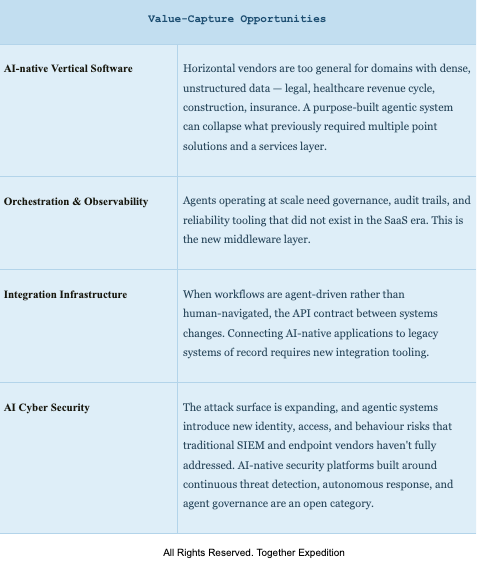
If we believe in this cycle refresh and some version of the AI agents continuing to be embedded in software applications changing what applications are, then new value-capture opportunities exist for a new group of builders and innovators.